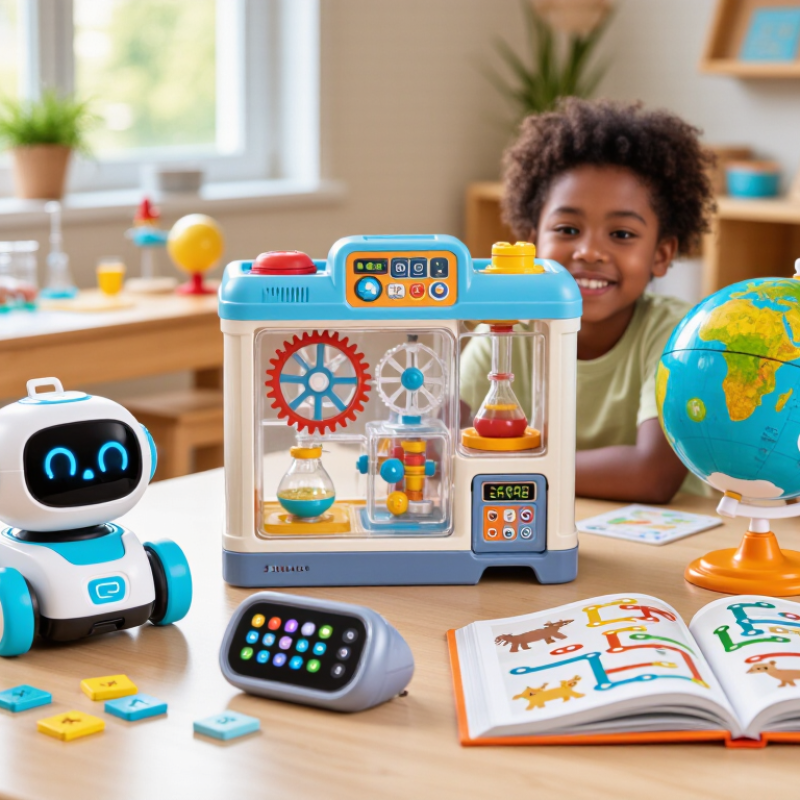
Smart learning toys are changing how children explore ideas, practice skills, and respond to feedback. These tools may include coding robots, interactive books, science kits, language devices, and adaptive learning games. Each type uses technology differently, but the educational purpose remains clear: encourage active learning through meaningful play.
Parents and educators often ask, “how can smart learning toys improve educational experiences?” They can make abstract concepts visible through lights, sounds, movement, and immediate responses. A coding robot, for example, can turn a printed path into a simple problem-solving challenge. An interactive globe can connect a child’s touch with geography, languages, and cultural knowledge. These experiences may support curiosity, persistence, digital confidence, and independent thinking when adults provide suitable guidance.
Technology alone is not enough. It can distract, oversimplify, or reward quick answers instead of deep understanding. Some toys also collect data, so privacy settings and age-appropriate design deserve careful attention. The strongest choices match a child’s developmental stage, learning goals, interests, and need for hands-on activity. Real classrooms and homes reveal something important: children learn differently, and no device works equally well for everyone. This guide examines ten major types of smart learning toys, including their practical benefits, limitations, and best educational uses. The goal is not to praise every gadget. It is to help families and teachers make informed decisions based on evidence, observation, and thoughtful play.
Top 10 Types of Smart Learning Toys for Education
A smart learning toy does more than light up or make sounds. It connects play with a clear learning purpose. Adaptive difficulty, immediate feedback, and simple progress records can help children practise at the right level. However, “smart” should not mean “more technology.” UNESCO’s 2023 Global Education Monitoring Report warns that technology improves learning only when its use is supported by evidence, teacher guidance, and suitable access. A toy should invite touching, building, speaking, or problem-solving. A screen alone is not educational.
Design quality matters too. Reliable toys use age-appropriate tasks, readable instructions, and privacy-conscious data practices. The OECD’s PISA 2022 report found that about 30% of students were distracted by classmates using digital devices during mathematics lessons. That finding deserves attention. A toy may increase engagement while weakening concentration. I would test whether a child can explain the skill without the toy. If not, the learning may be shallow.
Tips: Check the learning goal before buying. Watch for useful feedback, not endless rewards. Choose toys that allow mistakes and retrying. Ask whether adults can adjust difficulty without collecting unnecessary personal data. Short play sessions often work better. Not every beep teaches. Children also need quiet, hands-on time.
Smart learning toys are becoming practical tools for guided education, not simple sources of entertainment. The ten major types include coding robots, programmable building blocks, augmented-reality books, adaptive mathematics games, language-learning speech toys, science experiment kits, digital microscopes, electronic geography maps, music composition pads, and social-emotional storytelling devices. Each type supports a different learning goal. Coding robots develop sequencing through visible movement. Adaptive games adjust difficulty after repeated answers. Digital microscopes make a leaf vein or fabric thread surprisingly clear.
Tips: Choose one clear skill before buying a toy. Check whether children can solve problems without constant adult help. Look for adjustable volume, durable parts, and understandable instructions. Test data settings carefully, especially when a toy connects online. Offline options are often easier to supervise.
From classroom observations, children learn more when adults ask questions instead of giving quick solutions. A child might predict where a robot will turn, then revise the path after watching it fail. That small failure matters. It can feel frustrating. It also reveals real thinking. However, not every smart toy produces deep learning. Some rewards encourage fast tapping rather than careful reasoning. Teachers should compare screen time with hands-on work, conversation, drawing, and outdoor investigation. A reliable toy explains its learning purpose, supports gradual progress, and allows children to create, test, and rethink their ideas.
Top 10 Types of Smart Learning Toys for Education
Smart learning toys can build specific skills when adults observe, question, and adjust the activity. Coding robots develop sequencing, logic, and problem-solving through commands, turns, and simple debugging. Phonics readers strengthen sound recognition, vocabulary, and early reading confidence. Math manipulatives support counting, pattern awareness, spatial reasoning, and flexible calculation. Children can touch, move, and compare objects.
Language games encourage listening, speaking, memory, and conversational timing. Science experiment kits develop prediction, measurement, careful observation, and evidence-based thinking. The results may look messy. That is useful. Art and design toys improve creativity, fine-motor control, planning, and visual communication. Musical toys support rhythm, auditory memory, coordination, and emotional expression. Repetition matters more than constant novelty.
Interactive story devices develop comprehension, imagination, and moral reasoning through choices and consequences. Adaptive quiz toys can strengthen recall and reveal learning gaps, but they should not replace teacher judgment. Role-play toys build empathy, cooperation, self-regulation, and conflict-resolution skills. In practice, children often need longer pauses than product instructions suggest. Some toys also distract easily. A reliable choice includes clear goals, adjustable difficulty, safe materials, and meaningful adult interaction. Performance scores alone cannot show curiosity, persistence, or deeper understanding.
Key skills developed by each toy category
The index uses a 1–10 scale to show the primary educational skill most strongly associated with each toy category. The categories reflect widely recognized learning domains, including problem-solving, language development, fine-motor coordination, mathematical thinking, creativity, and social-emotional learning. Scores indicate relative skill emphasis rather than standardized test results.
Top 10 Types of Smart Learning Toys for Education?
Choosing smart learning toys should begin with the child, not the technology. For ages three to five, consider language readers, sensory tools, music toys, and simple matching games. They should have large controls, short activities, and clear feedback. The World Health Organization recommends limiting sedentary screen time for young children, so screen-free interaction remains important. Keep it simple.
For ages six to eight, coding robots, programmable blocks, math games, science kits, and interactive puzzles can build problem-solving skills. For older children, design platforms, engineering kits, augmented-reality puzzles, and collaborative game systems may support deeper projects. The OECD’s PISA 2022 report found that about 30% of students were distracted by digital devices during mathematics lessons. That finding matters: connected features should support attention, not compete for it. Battery life, privacy settings, washable parts, and offline access deserve equal attention.
Educational claims need evidence. UNESCO’s 2023 Global Education Monitoring Report noted that technology’s learning benefits are mixed and often depend on teacher guidance. Check whether a toy encourages explanation, practice, and independent thinking. A flashy robot may produce excitement, but excitement is not mastery. I would also test the toy myself before purchase. Some instructions feel confusing, and children notice that quickly. The best choice may be less intelligent, but more usable.
| No. | Smart Toy Type | Recommended Age | Primary Learning Benefits | Typical Smart Features | Best Choice for Different Needs | Key Selection Criteria |
|---|---|---|---|---|---|---|
| 1 | Interactive Coding Robots | 5–12 years | Develops sequencing, problem-solving, logical thinking, spatial reasoning, and early computational thinking. | Programmable movement, drag-and-drop coding, sensors, light or sound feedback, and adjustable challenge levels. | Children interested in technology, engineering, robotics, or hands-on problem-solving. | Choose screen-free controls for younger children, gradual difficulty, durable parts, and clear programming instructions. |
| 2 | Electronic Building and Construction Sets | 6–14 years | Supports engineering design, fine motor coordination, creativity, cause-and-effect reasoning, and persistence. | Modular components, motors, switches, sensors, circuit modules, and guided project challenges. | Visual-spatial learners and children who prefer building, experimenting, and creating physical projects. | Check that components are age-appropriate, connections are secure, instructions are progressive, and small parts are unsuitable for toddlers. |
| 3 | Augmented Reality Learning Kits | 6–14 years | Can improve visualization of science, geography, language, and historical concepts through interactive models. | Camera-based overlays, 3D models, animations, quizzes, audio narration, and interactive content layers. | Learners who benefit from visual demonstrations or need additional support understanding abstract ideas. | Look for accurate educational content, short activity sessions, privacy-conscious apps, and options that work without constant internet access. |
| 4 | Smart Reading Pens and Audiobook Devices | 3–10 years | Encourages vocabulary growth, listening comprehension, phonics practice, pronunciation, and independent reading. | Audio playback, word pronunciation, read-along functions, touch-activated content, and progress tracking. | Beginning readers, bilingual learners, children with reading difficulties, and independent learners. | Select age-appropriate content, adjustable volume, offline access, replaceable or rechargeable batteries, and a comfortable grip. |
| 5 | Interactive Language Learning Toys | 2–8 years | Builds early vocabulary, listening skills, pronunciation awareness, memory, and basic conversational confidence. | Voice prompts, repetition activities, songs, pronunciation feedback, multiple language settings, and responsive buttons. | Young children learning a second language or children who learn effectively through sound and repetition. | Prioritize clear pronunciation, culturally appropriate content, limited advertising, simple controls, and privacy-respecting voice functions. |
| 6 | Smart Mathematics and Numeracy Games | 4–10 years | Practices counting, number recognition, addition, subtraction, patterns, measurement, and mental calculation. | Adaptive difficulty, instant feedback, visual counters, timed or untimed modes, and progress records. | Children who need extra numeracy practice or prefer game-based repetition. | Choose products that explain errors, allow untimed practice, match school learning goals, and avoid excessive rewards or pressure. |
| 7 | Electronic Science Experiment Kits | 8–15 years | Introduces observation, hypothesis testing, measurement, data interpretation, and scientific reasoning. | Digital sensors, temperature or light measurement, guided experiments, data displays, and interactive explanations. | Curious learners interested in biology, physics, environmental science, or practical investigation. | Review experiment safety, adult supervision requirements, material quality, data accuracy, and the availability of replacement supplies. |
| 8 | Music and Rhythm Learning Devices | 3–12 years | Develops rhythm, auditory discrimination, memory, coordination, creativity, and basic musical structure. | Tempo control, guided lessons, illuminated keys or pads, recording functions, and immediate performance feedback. | Children interested in music or learners who respond well to auditory and movement-based activities. | Check volume limits, responsive controls, progressive lessons, comfortable design, and opportunities for open-ended creativity. |
| 9 | Programmable Storytelling and Creative Media Toys | 5–12 years | Strengthens narrative structure, communication, creativity, sequencing, collaboration, and digital media literacy. | Story prompts, character controls, audio recording, scene sequencing, simple animation, and collaborative modes. | Creative learners who enjoy writing, acting, storytelling, or combining technology with imaginative play. | Choose tools with child-friendly content controls, export or saving options, offline functions, and no unnecessary social-sharing features. |
| 10 | Interactive Geography and World Discovery Toys | 4–12 years | Builds knowledge of continents, locations, cultures, landmarks, spatial relationships, and global awareness. | Touch-sensitive maps, audio facts, quizzes, location challenges, digital overlays, and updated educational content. | Visual learners and children interested in travel, geography, history, or cultural learning. | Check geographic accuracy, inclusive cultural representation, map readability, update support, and the suitability of facts for the child’s age. |
General selection note: Always follow the manufacturer’s age guidance, inspect toys for loose or damaged parts, supervise activities involving batteries or small components, and review app permissions before connecting a smart toy to the internet.
Top 10 Types of Smart Learning Toys for Education?
Smart learning toys can include coding kits, talking books, programmable robots, electronic puzzles, language devices, science kits, drawing tablets, interactive globes, music tools, and augmented reality sets. Their value depends on safe design and thoughtful adult guidance. Check age recommendations, loose parts, battery covers, charging heat, and sound levels. A five-year-old should not handle tiny components alone. Keep devices away from water and inspect damaged cables immediately.
Privacy deserves equal attention. Before connecting a toy, review its microphone, camera, location, and account permissions. Choose offline activities when possible. Use a strong, unique password and update the software from trusted sources. Avoid entering a child’s full name, school, face image, or daily routine. I have found that shared family tablets often save more data than adults expect. That deserves regular checking. Children should also know when a toy is listening.
Tips: Treat the toy as a learning prompt, not an electronic babysitter. Set a short play period, then ask the child to explain the activity without help. Keep an adult nearby during online features. Test the toy yourself first. Some instructions look simple but confuse children. If the child becomes frustrated, pause the device and switch to hands-on play. Perfect control is unrealistic, but careful habits make the experience safer and more useful.
It connects play with a clear learning goal.
They develop sequencing, logic, planning, and problem-solving.
They adjust questions after repeated answers and reveal possible learning gaps.
No. A screen alone does not create meaningful learning.
Check the learning goal, age suitability, instructions, durability, and adjustable volume.
They invite children to predict, measure, observe, and compare results.
They can strengthen listening, vocabulary, speaking, memory, comprehension, and conversational timing.
Sometimes, but not automatically.
Short sessions often work better than long, repetitive play.
It has clear goals, safe materials, understandable instructions, and adjustable difficulty.
Smart learning toys combine interactive technology with purposeful educational design to make play more engaging and meaningful. They may include coding kits, robotic toys, interactive books, electronic puzzles, language-learning devices, science experiment sets, augmented reality tools, creative drawing systems, math games, and adaptive learning companions. Each category supports different skills, such as problem-solving, communication, creativity, logical thinking, coordination, collaboration, and independent learning. The key question is: how can smart learning toys improve educational experiences? They can provide immediate feedback, adjust challenges to a child’s level, encourage curiosity, and turn abstract ideas into hands-on activities.
Choosing the right toy depends on the child’s age, interests, developmental stage, and learning goals. Parents and educators should review age recommendations, physical safety, durability, data privacy, and screen-time requirements before making a decision. Smart toys are most effective when adults participate, ask questions, connect play to real-life situations, and balance digital interaction with reading, movement, social play, and open-ended creativity.

FourE Toy