How to Compare Traditional and Electronic Learning Toys?

Time:2026-09-16 Author:Aria
0%

Choosing between traditional and electronic learning toys can feel simple until a child uses both at home. A wooden puzzle may invite quiet concentration at the kitchen table. A talking tablet may provide instant sounds, bright feedback, and adjustable challenges. Yet entertainment does not always equal learning. Parents, teachers, and childcare professionals should examine how each toy supports attention, language, movement, creativity, and independent problem-solving.

A useful starting question is: what are the differences between traditional and electronic learning toys? Traditional toys often depend on imagination, hand control, and social interaction. Blocks, picture cards, and pretend-play sets have no charging cable or programmed pathway. Electronic toys can offer responsive instructions, progress tracking, and varied sensory input. These features may support practice when designed carefully and used with adult guidance. However, flashing screens can distract children, while automated hints may reduce productive struggle. The right choice depends on age, developmental needs, learning goals, and the child’s response.

Evidence-based decisions require more than attractive packaging or confident advertising. A teacher might observe whether a child explains a puzzle strategy, rather than merely tapping correct answers. A parent could compare ten minutes of independent play with ten minutes of guided play. Small details matter, including volume, durability, privacy settings, and repairability. Neither category is perfect. Traditional toys can become repetitive, while electronic toys can encourage passive use. This comparison therefore considers benefits, limitations, safety, and real-world experience, helping families choose toys that support meaningful learning instead of replacing human connection.
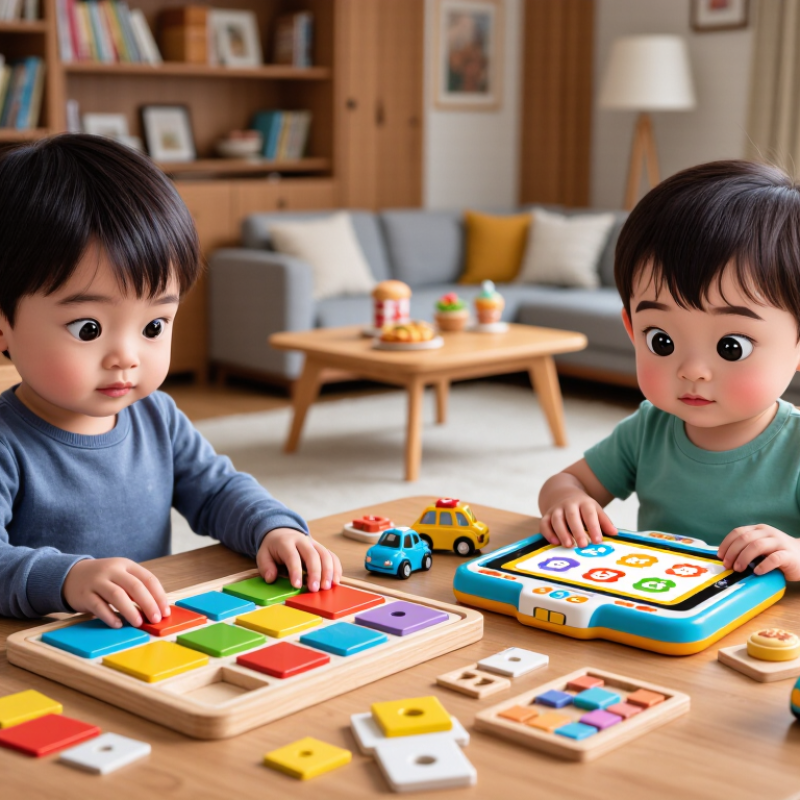
How to Compare Traditional and Electronic Learning Toys?

Definitions and Core Features of Traditional and Electronic Learning Toys

Traditional learning toys are hands-on objects designed to support learning through physical activity. They include blocks, puzzles, counting cards, shape sorters, and simple science kits. Their core features are tactile feedback, open-ended play, and direct control by the child. A child can stack three wooden blocks, knock them down, and try again. The toy does not decide the next step. They stay quiet. That matters.

Electronic learning toys use batteries, screens, lights, speakers, sensors, or programmed responses. They may teach letters, numbers, music, problem-solving, or language through animated feedback. A button can produce a sound, while a sensor can identify a correct answer. These features offer quick responses and adjustable difficulty. However, bright effects may attract attention without creating deep understanding.
Not always.

A reliable comparison should examine the learning goal, not the toy’s appearance. Traditional materials often encourage imagination, fine-motor practice, and social conversation. Electronic tools can support repetition, pronunciation, and immediate correction. Adult guidance remains important for both types. Caregivers should check age recommendations, volume levels, small parts, and whether instructions match a child’s abilities. My first impression was too simple: I once viewed electronic feedback as automatically helpful. In practice, a quiet puzzle may create richer discussion than a noisy quiz. A balanced choice depends on the child, the activity, and how the toy is used.

Learning Goals and Skills Supported by Each Toy Type

Traditional learning toys often turn learning into physical problem-solving. Wooden blocks support spatial reasoning, balance, counting, and early engineering. A child can build a bridge, test its strength, and revise the design. Puzzles strengthen visual discrimination, patience, and planning. Pretend-play materials develop language, negotiation, and emotional understanding. These skills grow through conversation and repeated hands-on practice. I have seen children use the same blocks differently each week. Their goals changed with confidence. Traditional toys usually offer fewer built-in instructions. That can encourage imagination, but it may also frustrate children who need clearer guidance. I sometimes underestimate that barrier.

Electronic learning toys can provide immediate feedback for specific goals. A phonics game may connect letter sounds with spoken examples. A counting activity can show errors without embarrassment. Touch, sound, and movement may support memory for some learners. Short challenges can practise attention, sequencing, and hand-eye coordination. However, digital feedback is not the same as understanding. A child might tap the correct answer without explaining it. Adult questions still matter. Ask, “How did you know?” and “Can you solve it another way?” In my experience, electronic toys work best during brief, focused sessions. Traditional toys leave more room for social language and flexible thinking. Electronic toys can make progress easier to observe, yet their pace may become distracting.

Comparing Interaction, Feedback, and Child Engagement

Traditional learning toys create interaction through touch, movement, and conversation. A child stacks wooden blocks, hears a piece fall, and adjusts the next attempt. The feedback is immediate, but usually indirect. Adults must notice the mistake and offer guidance. This slower exchange can support patience and shared attention.

Electronic toys provide faster feedback. Lights, sounds, and changing levels can reward a correct response within seconds. The Joan Ganz Cooney Center reported that children often learn more from digital tools when adults guide their use. However, instant rewards may encourage guessing instead of thinking. Common Sense Media’s 2020 Census found that children aged zero to eight spent an average of 2 hours and 24 minutes daily with screen media. That figure does not prove electronic toys are harmful, but it raises a practical question: does the device deepen play, or simply extend screen time?

Child engagement is not measured by noise or repeated button pressing. Watch for focused eyes, purposeful questions, and attempts after failure. Traditional toys often leave room for imagination, while electronic toys can offer structured challenges and adaptive feedback. Neither format is automatically better. In my observations, electronic feedback sometimes feels impressive but becomes predictable quickly. A block tower can also become frustrating, yet that frustration may invite problem-solving. Caregivers should compare the quality of interaction, not just the number of features.

How to Compare Traditional and Electronic Learning Toys? - Comparing Interaction, Feedback, and Child Engagement

Evidence-informed comparison of common characteristics. Actual results vary according to the toy's design, the child's age, the learning goal, and adult involvement.
Comparison Dimension Traditional Learning Toys Electronic Learning Toys Impact on Child Engagement and Learning
Primary Interaction Hands-on
Children manipulate physical pieces, turn pages, build structures, sort objects, or use pretend-play materials.
Screen- or sensor-mediated
Children interact through buttons, touchscreens, motion sensors, microphones, lights, sounds, or programmed responses.
Physical manipulation often supports direct exploration and fine-motor practice, while electronic interaction can provide varied modes of input and rapid responses.
Feedback Speed Feedback is usually delayed or provided by the child, a peer, or an adult. The child may need to compare, test, and revise an action independently. Feedback is commonly immediate through sounds, animations, lights, scores, hints, or verbal prompts. Immediate feedback can clarify cause and effect, but delayed feedback may encourage persistence, reflection, and self-monitoring.
Feedback Flexibility Feedback can be open-ended and adapted by the child or adult. There may be several acceptable solutions. Feedback is usually programmed and may follow predetermined rules, answer choices, or progression levels. Open-ended feedback supports creativity and multiple strategies; programmed feedback can support structured practice and clear task goals.
Sensory Experience Provides tangible qualities such as weight, texture, shape, resistance, spatial position, and movement in three-dimensional space. Can combine visual, auditory, and sometimes motion-based stimulation, although physical texture and resistance may be limited. Traditional materials may offer richer tactile exploration, whereas electronic toys can attract attention through coordinated audiovisual cues.
Child Agency Children often decide what to build, how to use an object, and when to change the activity without a fixed sequence. Agency depends on the design. Some toys allow creative choices, while others direct the child through levels, prompts, or preset activities. Higher agency generally supports ownership and imaginative play; excessive prompts may reduce independent decision-making.
Open-Ended Play Often supports pretend play, construction, storytelling, experimentation, and more than one possible outcome. Open-ended potential ranges from limited to extensive. Tools that allow creation or exploration may be open-ended, while quiz-based toys are more structured. Open-ended activities can promote creativity, language use, planning, and flexible problem-solving when children have sufficient time to explore.
Cognitive Engagement Commonly requires children to plan actions, remember rules, visualize relationships, and solve problems without continuous automated guidance. Can provide graduated difficulty, adaptive prompts, repeated practice, and multimodal explanations. Electronic support may help maintain task focus, but learning is stronger when children explain, predict, and apply ideas rather than simply follow prompts.
Social Interaction Frequently encourages face-to-face cooperation, negotiation, turn-taking, shared construction, and verbal storytelling. Social interaction depends on the activity. Shared electronic play can promote collaboration, while solitary use may reduce direct conversation. Adult or peer participation can increase language-rich interaction in both formats; the toy should not replace responsive human engagement.
Adult Mediation Adults may need to explain rules, model strategies, ask questions, or help children interpret results. The toy may provide built-in instructions and corrections, but adults still need to monitor content, difficulty, privacy, and the child's understanding. Adult guidance is most valuable when it extends thinking with questions and conversation instead of giving answers or controlling every step.
Attention Pattern Engagement is often sustained through physical activity, imagination, challenge, and social interaction rather than continuous stimulation. Animated effects, sound, rewards, and changing tasks may capture attention quickly and help maintain short-term focus. Capturing attention is not the same as deep learning. Meaningful engagement is indicated by active thinking, persistence, explanation, and transfer.
Error and Persistence Errors may be less obvious, requiring children to notice problems and try different approaches. Errors may be clearly signaled and followed by hints, corrections, or another attempt. Clear guidance can reduce frustration, while opportunities to struggle productively help children develop persistence and independent strategies.
Language Development Conversation, storytelling, role-play, and collaborative construction can naturally generate descriptive and social language. Spoken instructions and vocabulary prompts may support language exposure, but prerecorded speech provides less reciprocal communication than a conversation partner. Toys are more likely to support language growth when children discuss ideas, explain choices, and respond to adults or peers.
Adaptability to Different Learners Adults can adjust the rules, materials, pace, and difficulty using the same physical toy. Some products offer adjustable levels, repetition, accessibility settings, or personalized tasks; others provide little flexibility beyond preset options. Adaptability should be assessed by observing whether the toy matches the child's developmental level, interests, sensory needs, and learning objective.
Distraction Risk Distractions usually come from the environment, competing materials, or unclear activity goals. Excessive animation, sound, rewards, rapid pacing, or unnecessary features may shift attention from the intended learning task. Simple, purposeful design generally makes it easier for children to focus on the relevant concept or skill.
Best-Fit Learning Uses Particularly suitable for sensory exploration, imaginative play, construction, social games, physical coordination, and open-ended problem-solving. Particularly suitable for guided practice, simulations, interactive stories, pronunciation support, digital creation, and immediate formative feedback. A balanced play environment can combine physical exploration and social interaction with carefully selected digital activities that add genuine learning value.

Evaluating Safety, Accessibility, Cost, and Durability

Comparing learning toys begins with the child’s hands, not the feature list. Traditional toys usually offer visible parts and predictable responses. Electronic toys add batteries, wiring, heat, sound, and sometimes wireless connections. The U.S. Consumer Product Safety Commission reported 198,100 toy-related emergency-department injuries among children under 15 in 2022. That figure does not prove electronic toys are riskier. It does show why adults should inspect small parts, battery doors, magnets, edges, and sound levels. A loose button battery is a serious warning sign. Test it before purchase.

Accessibility changes the comparison. The WHO and UNICEF Global Report on Children with Developmental Disabilities estimates that nearly 240 million children live with disabilities worldwide. A tactile puzzle may support children who avoid flashing lights or complex controls. Electronic toys can provide speech, repetition, adjustable contrast, and immediate feedback. Yet touch screens may frustrate children with limited motor control. Physical switches can feel better. UNICEF and ITU reported that 2.2 billion children and young people lacked internet access at home in 2020, although not every electronic toy needs connectivity.

Cost is more than the shelf price. Include batteries, charging time, replacement parts, and possible repairs. Traditional toys often survive rough handling because fewer components can fail. Electronic toys may offer richer feedback, but one damaged circuit can end their useful life. I would test a toy on the floor, check its volume, and examine its seams. My judgment may still be imperfect. A simple toy can be under-stimulating, while a clever one can become expensive clutter. Durability should mean repeated meaningful play, not merely surviving a drop.

How to Compare Traditional and Electronic Learning Toys?

Comparison based on four practical criteria. Scores range from 1 to 5, where 5 indicates a more favorable result. Cost is scored for affordability, while safety, accessibility, and durability reflect general product characteristics.

Summary: Traditional learning toys generally score higher for affordability, durability, and safety because they have fewer electronic components. Electronic learning toys may offer broader accessibility through sound, visual feedback, and interactive features, but they usually require batteries or charging and can be more expensive.

Choosing the Right Learning Toy for Different Ages and Needs

How to Compare Traditional and Electronic Learning Toys?

Choosing the Right Learning Toy for Different Ages and Needs

For babies under two, choose simple traditional toys with large parts, clear textures, and safe movement. A wooden ring, cloth book, or stacking cup supports grasping and shared attention. The World Health Organization recommends no sedentary screen time for infants under one and limited use for toddlers aged two to four. Real interaction matters more than flashing lights.

For preschool children, traditional toys encourage open-ended play. Blocks can become a bridge, a shop, or a small animal house. Electronic toys may add sound, feedback, or adjustable difficulty, which can help children practise letters and counting. However, the Common Sense Census reported that children aged zero to eight averaged two hours and twenty-four minutes of screen media daily in 2020. That figure makes balance necessary. Keep sessions short. Sit beside the child. Ask questions.

School-age children often need toys linked to specific needs. A child developing fine-motor skills may benefit from puzzles, construction sets, or drawing tools. Another child may enjoy an electronic coding toy with visible progress. Check whether the toy requires reading, memory, or advanced coordination. Age labels are useful, but they are not perfect. I have seen children abandon “easy” toys and persist with difficult ones. Observe the child’s frustration, curiosity, and independent play. The American Academy of Pediatrics also identifies play as important for language, social, emotional, and problem-solving development. A quiet toy can be surprisingly powerful.

FAQS

What skills do traditional learning toys support?

Blocks develop spatial reasoning, balance, counting, and early engineering. A child can build a bridge, test it, and change the design. Puzzles support visual matching, patience, and planning. Pretend play strengthens language and emotional understanding. Play grows through repetition. Some children need clearer guidance, though.

How do electronic learning toys support learning?

Electronic toys can provide quick feedback for sounds, counting, sequencing, and attention. A phonics activity may connect letters with spoken examples. A counting game can show mistakes without embarrassment. Touch and sound may support memory. Still, tapping is not understanding. Ask, “How did you know?”

Are traditional toys safer than electronic toys?

Neither type is automatically safer. Adults should inspect small parts, magnets, sharp edges, battery doors, and sound levels. A loose button battery requires immediate attention. Check the toy before use. Safety needs regular checking. Electronic toys also include wiring, heat, and charging parts.

How can learning toys support children with different needs?

Tactile puzzles may help children who dislike flashing lights or complicated controls. Electronic toys can offer speech, repetition, adjustable contrast, and immediate feedback. Touch screens may frustrate children with limited motor control. A physical switch might feel easier. Observe the child’s hands. Accessibility is not identical for everyone.

What should adults consider besides the purchase price?

Include batteries, charging time, replacement parts, and possible repairs. Traditional toys often have fewer parts that can fail. One damaged circuit may end an electronic toy’s usefulness. Test the volume and inspect the seams. Costs can hide. A simple toy may become clutter, while an advanced toy may receive little use.

Which toys suit babies and toddlers?

Choose large parts, clear textures, and simple movement for very young children. Wooden rings, cloth books, and stacking cups support grasping and shared attention. Real interaction matters more than flashing lights. For infants, avoid sedentary screen activities. Keep play physical. My judgment can still miss an individual child’s preference.

How should preschool children use traditional and electronic toys?

Blocks can become bridges, shops, or small animal houses. Electronic toys may practise letters, counting, and adjustable challenges. Keep electronic sessions brief and sit beside the child. Ask questions during play. Balance matters. Children may learn more from one conversation than many prompts.

How can adults choose toys for school-age children?

Match the toy with the child’s current needs, such as fine-motor control or planning. Puzzles, construction sets, and drawing tools can strengthen hand skills. Coding toys may show visible progress for some learners. Check reading, memory, and coordination demands. Watch frustration and curiosity. Age labels are helpful, but imperfect.

Conclusion

Understanding what are the differences between traditional and electronic learning toys helps parents and educators choose tools that match a child’s development. Traditional toys, such as blocks, puzzles, art materials, and pretend-play sets, encourage hands-on exploration, imagination, problem-solving, and social interaction. Electronic toys may offer lights, sounds, digital challenges, and immediate responses that support early learning, memory, language, and basic technology skills. However, their value depends on thoughtful design and active adult guidance rather than passive entertainment.

When comparing these toy types, consider how children interact with them, the quality of their feedback, and whether they remain engaged through independent or cooperative play. Safety, accessibility, price, battery or maintenance needs, and durability are also important factors. Younger children may benefit from simple, sensory, and open-ended toys, while older children may enjoy more structured challenges. The best choice is often a balanced combination that suits the child’s age, interests, abilities, learning goals, and need for creativity, movement, and meaningful interaction.

Aria

Aria

Aria is a dedicated marketing professional with a deep passion for innovative strategies and a keen understanding of our company's product offerings. With a wealth of experience in the industry, Aria excels at crafting engaging content that highlights the unique features and benefits of our......