China Top Electronic Toys That Build Kids STEM Skills

Time:2026-09-26 Author:Mason
0%

Electronic toys can turn abstract STEM ideas into visible actions. A small robot rolls across the floor. Its wheels respond when a child changes a command. A simple circuit lights an LED when its parts connect correctly. These moments invite children to observe, test, and try again.

Parents often ask, “what electronic toys help children develop stem skills”? The answer depends on a child’s age, interests, and patience. Coding robots can introduce sequencing through short, playful tasks. Beginner circuit kits make connections and basic cause-and-effect easier to see. Electronic building sets add design challenges, while science toys can encourage questions about sound, motion, or light. The best fit is not always the most advanced one.

Start with clear instructions and age guidance. Check that small parts, batteries, and charging methods suit the child and the product’s stated use. Stay nearby when younger children explore. Look for toys that allow open-ended experiments, not just one correct result. That matters.

A child may build a lopsided rover, press the wrong button, and learn more from the repair than the demonstration. Still, electronic toys do not teach STEM by themselves. Curious conversation, patient guidance, and time to explore make a difference. Some kits can frustrate beginners; a simpler toy may lead to richer play. This guide highlights electronic toys available from Chinese brands and makers, with attention to hands-on learning, usability, and practical selection.
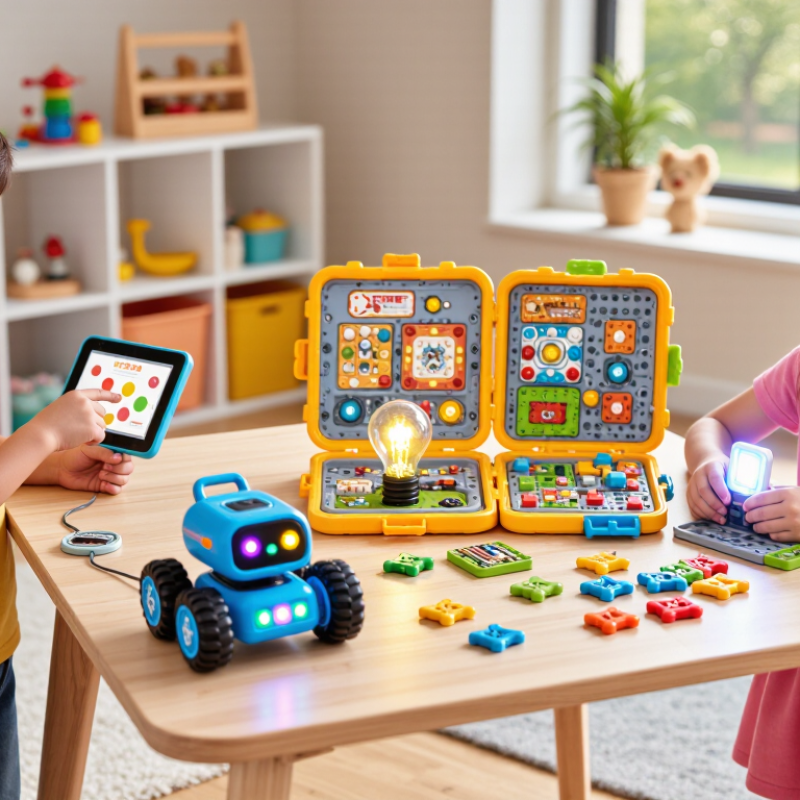
China Top Electronic Toys That Build Kids STEM Skills

Types of STEM-Focused Electronic Toys Made in China

China’s electronic toy factories now produce more than simple light-up gadgets. Their STEM-focused range includes programmable robots, coding boards, sensor kits, circuit-building sets, and remote-controlled engineering models. Many use modular parts, allowing children to connect motors, LEDs, switches, and distance sensors on a kitchen table. This hands-on format makes invisible ideas visible.

The World Economic Forum’s Future of Jobs Report 2023 ranked analytical thinking as the most important core workplace skill. Creative thinking ranked second. These findings support toys that require testing, debugging, and redesigning, rather than pressing one button repeatedly. Chinese manufacturers also commonly offer block-based coding, beginner robotics, and electronic construction kits for different age groups. A useful kit should include clear wiring diagrams, safe low-voltage components, and replaceable parts. Small details matter.

The OECD’s PISA 2022 assessment covered nearly 690,000 students across 81 economies. It found that mathematical problem-solving remains a major educational challenge. Electronic toys cannot replace skilled teaching, though they can create practical learning moments. A child may connect a sensor incorrectly, watch the robot stop, and try again. That failure is valuable. Still, some products exaggerate their educational claims. Buyers should check testing documentation, age guidance, material information, and instruction quality before purchasing.

How Electronic Toys Introduce Science, Technology, Engineering, and Math

China Top Electronic Toys That Build Kids STEM Skills

Electronic toys can make science visible through sound, light, motion, and simple feedback. A circuit kit may show how electricity travels between a battery, switch, and small lamp. Children can predict what will happen, test the connection, and adjust one part at a time. This process builds early scientific thinking without turning play into a lecture. Some results may fail. That is useful.

Technology becomes clearer when children program lights, sensors, or moving parts. They learn that instructions must be precise, and small changes can create different results. Engineering appears when a child designs a bridge, vehicle, or robotic arm. The structure may bend or stop. Children then compare materials, revise their designs, and try again. Mathematics enters through counting components, measuring distance, timing movement, and recognizing patterns. These experiences are practical, but they are not automatically educational. Adult guidance still matters.

Tips: Choose toys with adjustable difficulty and readable instructions. Ask, “What changed?” before giving an answer. Encourage children to draw a circuit or record test results. Check battery compartments, loose wires, and small parts regularly. Use age-appropriate equipment and supervise younger children. Avoid correcting every mistake; independent testing builds confidence. Still, some toys promise deep learning but offer repetitive button pressing. Inspect the activity before buying. A colorful interface is not always meaningful STEM practice.

How Electronic Toys Introduce STEM

This illustrative curriculum mapping counts how many STEM disciplines—science, technology, engineering, and math—are involved in each activity. It describes activity features, not measured learning outcomes.

Key Learning Skills Developed Through Play

Electronic toys can make STEM ideas visible through small, hands-on challenges. A child might press a sensor, watch a light respond, then change one step to test a new result. This simple loop introduces cause and effect. It also invites careful observation. What changed? What stayed the same? The questions matter more than getting the answer right immediately.

Building or programming a toy can strengthen sequencing and problem-solving. Children decide what should happen first, then adjust when a wheel turns the wrong way or a sound plays too soon. Those moments call for patience. They also give children practice explaining their thinking, especially when they play with a sibling or adult. A small shared task can prompt useful conversation: “What if we move this piece?” Fine-motor skills may develop as children fit connectors together or tap controls, though every child works at a different pace.

Play is not always neat. A toy may frustrate a child, or its instructions may need an adult’s help. That is worth noticing, rather than assuming every activity teaches equally well. Gentle questions and room to experiment can keep the focus on learning instead of speed. A short turn, a failed attempt, and one more try can be enough for a child to practice persistence.

Age-Appropriate Features and Ways to Compare Toys

For preschoolers, choose electronic toys with large controls, clear cause-and-effect, and short play cycles. A child should be able to press one button and see a light, hear a gentle sound, or move a piece. For ages five to seven, simple coding sequences, sorting challenges, and adjustable difficulty can add useful practice. Older children may enjoy sensors or beginner robotics, but check whether the instructions match their reading level. Age labels help, though they cannot predict every child’s patience or fine-motor skills.

Compare more than feature counts. Check sound volume, battery access, material sturdiness, and whether the toy still works without an app. Ask what the child actually does: make choices, test ideas, and try again, or mostly watch flashing effects? The distinction matters. Common Sense Media’s 2020 Census reported that children aged zero to eight spent an average of two hours and 24 minutes daily with screen media. That figure covers many kinds of media, not electronic toys specifically, but it supports checking whether a toy encourages active, shared play.

A practical comparison is to set the same small challenge for each toy, such as guiding a character through a simple path. Notice how often the child can solve a step independently and whether mistakes invite another try. Some toys promise broad STEM learning but offer only repetitive button pressing; that is easy to overlook in a product description. Look for durable pieces, understandable feedback, and room for open-ended experiments. One flaw may remain: a toy that suits a confident child can frustrate a beginner.

China’s Top Electronic Toy Types for Building Kids’ STEM Skills — Age-Appropriate Features and Ways to Compare

Toy Type Suggested Age Range Typical Electronic Features STEM Skills Practiced Best Fit For What to Compare Safety and Practical Checks
Programmable Floor Robot About 4–7 years; follow the age guidance on the specific product. On-device directional buttons, simple commands, and sometimes a grid mat or sound and light feedback. Sequencing, spatial reasoning, prediction, and early debugging. Young beginners who benefit from hands-on, screen-free activities. Check how many commands it can store, whether steps can be undone, and whether a play mat is included. Check battery type and whether the battery compartment is secured. Keep small accessories away from children who may mouth objects.
App-Connected Coding Robot About 6–10 years; choose the coding level and app setup to suit the child. Wireless connection to a tablet or phone; may use drag-and-drop blocks, sensors, lights, or movement. Algorithms, sequencing, loops, cause and effect, and basic problem-solving. Children ready to move from button-based commands to visual coding. Compare supported devices and operating systems, whether an app or account is required, and how much play is possible without a screen. Review app permissions and online features. Check whether a compatible device is needed but not included.
Snap-Together Circuit Kit About 8–12 years; younger children need close adult guidance. Connectable modules such as switches, LEDs, buzzers, and battery holders, depending on the kit. Simple circuits, conductivity, polarity, observation, and testing predictions. Children interested in how everyday electronic components work. Compare the number and variety of components, clarity of diagrams, project progression, and replacement-part availability. Choose a battery-powered, low-voltage kit designed for children. Never connect a toy circuit kit to household mains electricity.
Build-and-Code Robotics Kit About 8–14 years; complexity varies widely by build and software. Buildable parts with a motor and, in some sets, distance, light, or touch sensors; coding may use a computer or tablet. Mechanical design, measurement, iteration, sensor logic, and introductory programming. Children who enjoy constructing, testing, and improving a working model. Compare part count, build difficulty, included motors and sensors, coding language, device compatibility, and whether instructions offer open-ended projects. Check for small parts, tool requirements, and secure battery access. Younger builders may need help sorting and assembling pieces.
Handheld Digital Microscope About 6–12 years with adult support as needed. Illuminated lens with an onboard screen or a connection to a compatible device; features differ by model. Observation, classification, comparison, and evidence-based questions about specimens. Curious learners who enjoy examining leaves, fabric, or other safe everyday samples. Compare display size, focus controls, lighting, image storage, and whether a separate device or software is required. Check the stated optical specifications and included accessories. Use only safe samples; do not look at the sun or other intense light sources.
Electronic Music or Sound Kit About 6–12 years; select a kit with controls suited to the child’s dexterity. May include buttons, a small keyboard or pads, sound effects, recording, or simple circuit-based activities. Patterns, rhythm, cause and effect, sound exploration, and creative experimentation. Children who are motivated by music, sound, and making their own compositions. Compare the number of controls and sounds, recording options, speaker or headphone setup, and whether instructions encourage experimentation. Check volume controls and battery requirements. Use headphones at a comfortable volume and follow the product’s listening guidance.

Comparison note: Age ranges are general starting points, not guarantees; always follow the product’s stated age guidance and assess the child’s experience. When comparing China-made options, check applicable safety labeling for the intended market, battery security, build quality, clear instructions, language support, warranty terms, and availability of replacement parts. Features vary by product; no specific brand or company is endorsed.

Safety Standards and Responsible Use of Electronic Toys

Electronic toys can make STEM learning tangible, but safety begins before the first button is pressed. Check the age guidance, warnings, and safety marks required in your region. A toy suitable for an older child may contain small parts that are unsafe for younger siblings. Small details matter. Look for secure battery compartments, smooth edges, and wires that do not pull loose during ordinary play. Stop using a toy if its casing cracks or it becomes unusually hot. Rechargeable toys should be charged with the specified equipment, away from bedding and unattended children.

Responsible use also includes setting limits around play. Stay nearby when a child uses a solder-free circuit kit or a toy with moving parts, and show them how to switch it off. Keep charging cables out of walkways, and remove batteries before storing a toy for a long time. For connected toys, review microphone, camera, and data settings; children should not share personal details through a device. It is easy to focus on the coding challenge and overlook these routines. I would not treat a safety label as a substitute for supervision, either. A quick check before play can catch loose pieces, damaged plugs, or a missing cover.

FAQS

How do electronic toys support early STEM learning?

They make ideas visible through lights, sounds, motion, and feedback. A circuit kit can show electricity moving from a battery through a switch to a lamp. Children can predict, test, and adjust connections. Some results fail.

What skills can children practice?

They can follow instructions, recognize patterns, measure distance, count parts, and time movement. Building a bridge or vehicle invites design changes. A bent bridge can be a useful clue.

Which electronic toys suit preschoolers?

Choose large controls, clear cause-and-effect, and short play cycles. One button might light a lamp or move a piece. Less can be plenty.

What features suit children aged five to seven?

Try simple coding sequences, sorting tasks, and adjustable difficulty. Notice whether children make choices or mostly watch flashing effects. That difference matters.

How can I compare toys?

Give each toy the same small task, such as guiding a character along a path. Observe whether a child solves steps independently and tries again after mistakes. Product descriptions can miss important details.

How can adults encourage learning during play?

Ask, “What changed?” before explaining. Invite children to draw a circuit or record test results. Avoid fixing every error. Waiting can be difficult.

What safety checks matter?

Check age guidance, warnings, battery covers, smooth edges, and secure wires. Stop using a toy if its casing cracks or it becomes unusually hot. Keep small parts away from younger children.

How should connected or rechargeable toys be used?

Charge with the specified equipment, away from bedding and unattended children. Review microphone, camera, and data settings. Keep cables out of walkways, and remind children not to share personal details. A label is not enough.

Conclusion

China produces a wide range of electronic toys designed to make STEM learning engaging and accessible for children. These include coding robots, programmable building kits, electronic experiment sets, remote-control engineering models, and interactive science toys. Through hands-on play, children explore basic concepts in science, technology, engineering, and mathematics by testing circuits, following logical sequences, solving design challenges, measuring results, and improving their creations. This approach helps answer the question, “what electronic toys help children develop stem skills,” while showing how play can support meaningful learning.

Electronic toys can strengthen problem-solving, creativity, critical thinking, spatial awareness, teamwork, and early programming abilities. When comparing products, parents should consider the child’s age, skill level, battery requirements, difficulty, materials, and opportunities for open-ended exploration. Younger children may benefit from simple controls and colorful feedback, while older learners may enjoy coding and engineering challenges. Safe use is also essential, including choosing toys that meet recognized safety requirements, supervising play when necessary, checking components regularly, and using batteries and electronic parts responsibly.

Mason

Mason

Mason is a seasoned marketing professional with a deep expertise in the company's offerings and a passion for driving brand awareness. With a strong background in digital marketing strategies, he has an innate ability to connect with diverse audiences and effectively communicate product benefits.......