As families explore the 2026 best electronic learning toys for early education, careful selection matters more than bright screens. Parents want toys that teach, but young children also need movement, conversation, imagination, and quiet discovery.
So, how do electronic learning toys support early childhood education? Well-designed devices can introduce letters, numbers, sounds, problem-solving, and basic sequencing through short, responsive activities. A child may tap a picture, hear a word, and repeat it aloud. Another may arrange digital shapes while developing hand-eye coordination. These small interactions can make learning feel active rather than forced.
Developmental psychologist Kathy Hirsh-Pasek and her colleagues describe powerful learning experiences as “active, engaged, meaningful, socially interactive, iterative, and joyful.” That principle should guide every buying decision. An electronic toy should invite a parent or teacher into the activity, not replace them. It should encourage questions, turn-taking, storytelling, and real-world play after the battery is removed.
The strongest products often include adjustable difficulty, clear audio, durable controls, and limited distractions. However, no toy is automatically educational. Some offer flashy rewards but little lasting learning. That is an uncomfortable truth. Screen-based feedback can also frustrate children when instructions move too quickly. Adults should observe, listen, and adjust the activity. Ten focused minutes may be more valuable than an hour of passive tapping. This guide examines promising 2026 options through that practical lens, balancing technology with childhood’s need for human connection.
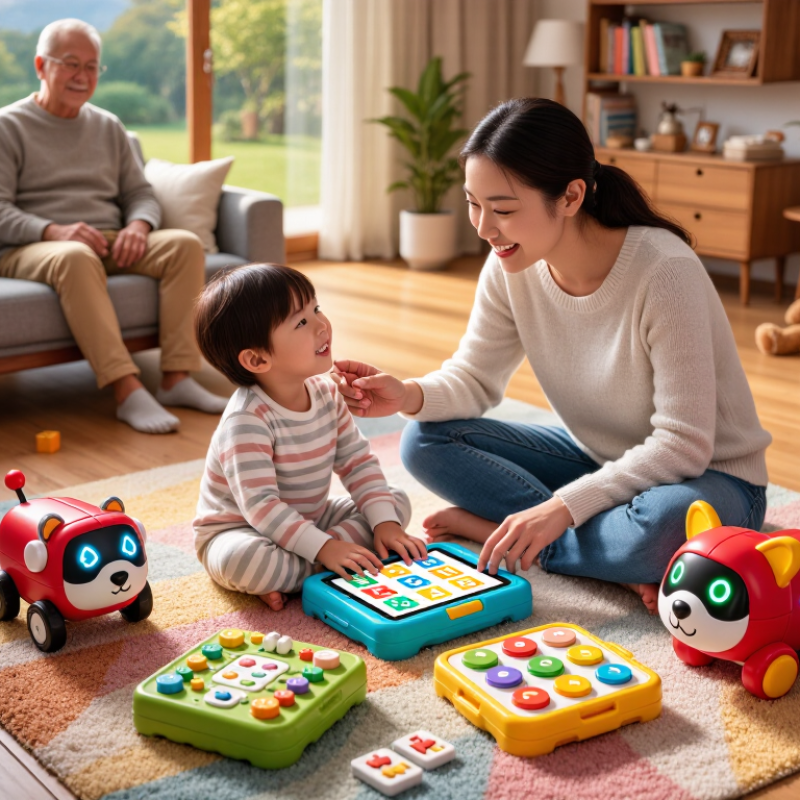
In 2026, an electronic learning toy should do more than light up, speak, or reward a button press. It should connect digital interaction with a clear early-learning goal. That goal might involve phonics, counting, spatial reasoning, music, or emotional vocabulary. Meaningful feedback matters. The toy should respond to a child’s attempt, not merely repeat praise.
UNESCO’s 2023 Global Education Monitoring Report warns that education technology has mixed effects without suitable guidance. Its evidence also notes that about one in four countries restricts smartphone use in schools. This supports a careful definition: a learning toy should encourage active play, short sessions, physical movement, and adult participation. It should also protect personal data, offer accessible controls, and function without constant internet access. Convenience is not proof of learning.
My practical test is simple. Can a child explain what they discovered after the screen goes dark? If the toy uses adaptive content, its adjustments should be understandable and age-appropriate. OECD’s PISA 2022 data found that about 30% of students reported distraction from digital devices during mathematics lessons. Younger children may be even more vulnerable to noise and novelty. I have seen attractive devices become quiet babysitters. That is a design failure, though not always an obvious one. A strong 2026 electronic learning toy leaves room for questions, mistakes, and hands-on discovery.
Can a child explain what they discovered after the screen goes dark?
It should connect digital play with a clear learning goal. That goal may involve counting, phonics, music, movement, or emotions. Lights alone do not prove learning. After play, ask what the child discovered.
Turn the screen off. Ask the child to explain the idea using paper, blocks, or objects. Can the child show another method? If not, the toy may be rewarding tapping instead of understanding.
Pediatric guidance recommends no more than one hour daily. This includes screens inside learning toys. Short sessions work better. Ten minutes may be enough.
Choose toys with clear stopping points and simple controls. Adjustable sound can protect a calm home environment. Physical movement is helpful. A timer helps, but adults still need to guide the ending.
Yes, especially during unfamiliar activities. Sit nearby and ask, “What changed?” Invite the child to compare, speak, move, or create. A dashboard is not proof of development.
Controls should match the child’s age and abilities. A younger child may need one clear action. A preschooler may sequence a story or solve a visual pattern. Endless buttons can create noise without purpose.
Prefer toys that support important activities offline. They should also protect personal data. Accessible controls matter. Convenience is not evidence of learning.
Watch for fading attention, rising frustration, or changed sleep. Repeated tapping may signal weak engagement. The child may become quiet rather than curious. I would reduce playtime before adding new features.
Some products describe themselves as educational without strong evidence. Observe behavior instead of trusting labels. Does the child talk, move, and make connections? I may judge too quickly, but visible transfer matters more.
This guide, “2026 Best Electronic Learning Toys for Early Education,” explains what makes an electronic learning toy valuable for young children. Effective products should offer age-appropriate activities, clear feedback, simple controls, and opportunities for active participation rather than passive consumption. The article connects toy design with NAEYC early-learning principles by emphasizing play, exploration, language development, problem-solving, creativity, and social interaction. It also asks, “how do electronic learning toys support early childhood education,” highlighting their potential to reinforce literacy, numeracy, early STEM concepts, and communication skills when used thoughtfully.
Safety and responsibility are equally important. For children ages two to five, daily use should remain within the AAP’s recommended one-hour screen-time limit, with adult guidance and regular offline play. Because children under thirteen may share personal information, privacy features should align with COPPA expectations. A practical evaluation matrix ranks each toy by literacy value, STEM support, accessibility, durability, ease of use, and cost, helping families and educators choose tools that are educational, safe, inclusive, and sustainable.

 FourE Toy
